Thursday, October 7, 2010

What is your communication style?

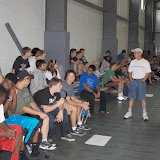
Shown at the board is SLP Deb Browne.
Photo by Lara Mazzone.

Students in several social-pragmatic language groups brainstormed and identified their “communication styles” recently.

This activity helps students begin to see their behaviors from the outside, as others see them.

Each student either underlined or a drew a symbol by descriptors for the various ways they communicate and received careful feedback from Speech-Language Pathologists and other students.

Styles suggested ranged from more positive styles like open, honest, playful on the left, to the more negative styles of gruff, argumentative, and rigid on the right side. Guess which words represent your child’s style?

During group and individual sessions, we discussed what situations bring out the best and worst in us as well as what styles we like to be around. The activity lays a fun foundation for understanding the “impression making” concepts. Through impression-making work, students realize the “ongoing idea of them” in other people’s minds, and how the impressions get created by what they say, what they do, and how they look. This provides internal motivation for many behaviors we want to develop.

Goals related to impression making and perspective taking are part of the Brehm Speech-Language Department’s use of the “social thinking” curriculum developed by SLP Michelle Winner.

A typed list was provided as an accommodation for those with visual processing difficulties who might find the colorful writing too chaotic.

Monday, September 27, 2010

Paintball season underway


The Brehm School Paintball Team spent the weekend training for their upcoming season.

Students set up camp later afternoon on Friday on Brehm’s campus. After going over the training schedule that evening, the students enjoyed a movie and then went “lights out.”

On Saturday, students had breakfast, a warm up and pep talk and broke into stations, which included “hand signals,” “bounding overwatch,” “crawling positions” and “executive functioning and paintball.”

Following a half-hour break, students broke into four more stations: “preemptive thinking,” “radio communications,” “woods walk/observation” and “tactical.”

Paintball team members enjoyed MREs (meals ready to eat) for lunch and broke into the last three stations for the day: “target practice,” “snap shooting,” “hasty attack” and “sliding.”

After practicing for a couple of hours, the students ate dinner and sat by the campfire before lights-out.

On Sunday, team members ate breakfast, broke into four more stations (“hasty ambush,” “follow the leader,” “zig zag” and “fugitive”), had lunch and put their skills to use in a two-hour long skirmish.

Wednesday, September 22, 2010

Student Council holds primary elections


Campaign season for the Brehm School Student Council is in full swing.

The weather was warm and sunny as students gathered in the lawn of the amphitheater area behind the Student Activities Center for speeches given by the candidates for Vice President and President of the Student Council.

Following the speeches, primary elections were held to narrow down the field of candidates.

Thursday, September 16, 2010

OPTIONS driver find success with music

James Anderson, a driver for the OPTIONS (Optimizing Potential Through Individualized, On-going, Nurtured Successes) Program at Brehm School, has shared his love of music with Brehm students for years, and now he is sharing it with the world.

James is a member of the Gospel group “Rapture 7,” which is receiving national attention after one of the songs - "Somebody's Knockin'" - off their new album “Security” was featured on the season 3 finale of True Blood – a series on HBO.

“We are blessed to have our music used on such a popular series,” James said.

James said he uses music to connect with the children he transports at OPTIONS – a comprehensive transitional program for students with learning disabilities who have graduated from high school, earned their GED or who have chosen to defer graduation in order to participate in a transitional program.

“The students all have a love for music, and I love all genres of music, so we use music as a way to bond,” James said. “Through our love of music, we all share in a moment of listening enjoyment during our driving times.”

Rapture 7 members include:
  • James – keyboard, lead guitar, songwriter and recording engineer from Carbondale, IL
  • Warren Grigsby Jr – lead vocals, songwriter, and business manager from Marion, IL
  • Leo Wilson Jr. – bass player, songwriter, and recording engineer from Carbondale, IL
  • Shamar Jordan – keyboard from Centralia, IL Ed “Bam Bam” Baker – drums from Chicago, IL
  • Daryl Frazier – lead and background singer and songwriter from Carbondale, IL
  • Bobby Simon – lead and background singer, songwriter and equipment technician from Carbondale, IL
  • Darren Grigsby – background singer, back-up drummer and songwriter from Marion, IL
  • Carl Hughlett – lead vocals, background singer and songwriter from Carbondale, IL.

Wednesday, September 15, 2010

Cooking up fun on Wednesday afternoon


Brehm School students cooked up a good time in Dorm 5 with some cooking lessons from Tamiko Foster, recreation staff worker.

Dorm 1 dresses in style


There's no doubt that the students in Brehm School's Dorm 1 have style, and they showed it on Wednesday for their "Dress Up Day."


Tuesday, September 14, 2010

Rec activities keep campus hopping


Students at Brehm School enjoyed the beautiful weather on Tuesday during their recreational activities.

Students could choose from flag football, walking, golf and swimming.

The recreation program is designed to encourage students to participate in structured activities that teach them new skills. Students have fun, develop balance in their social interactions, increase their self-esteem, gain new experiences, learn to plan and set goals, increase their awareness of leisure resources, and develop culturally and emotionally.

Friday, September 10, 2010

BPA Ambassador Program off to a great start


The Brehm Parents Association’s Ambassador Program is off to a great start this school year. The program pairs family members of returning students with new student families. The “Ambassadors” answer questions about the Brehm experience and other questions that arise regarding Brehm and the Carbondale area.

“Parents who have had their children enrolled at Brehm volunteer to speak with new families about what to expect at Brehm and to address any concerns that new parents may have,” said Diane Field, BPA member. “We all understand how difficult of a decision it is to send our children away when they are still so young. By speaking with someone who has already done it, it is hoped that new parents will feel less anxious about their decision.

“It is also a chance for new parents to ask questions that they might not want to ask the administration,” Diane continued. “For example, new parents may want to know how van runs work and what types of activities our children participated in during that time. Or they may want to ask, ‘What type of clothes should a new student bring with them?’ ‘How is the food?’ Anything that new parents want to know about, our Ambassadors are happy to discuss.”

Diane said she remembers how the Ambassador Program helped her when she was a new Brehm parent.

“Hearing a friendly voice reassuring me that things were going to be fine, really helped me get over my fears of sending my son away to Brehm,” Diane said. “Plus, I learned some valuable information about how most of the students from Chicago take the Amtrak together from Carbondale to Chicago over Thanksgiving - how they stick together during the trip, with the older ones looking after the younger ones. I would never have considered letting my son take the Amtrak when he was a freshman until I heard that from my Ambassador. It’s been a great experience for Andrew and hearing this from another parent gave me the courage to let him take this big step toward independence. This type of information you only learn from other parents.”

Maureen Wielansky, BPA President, remembers her Ambassadors.

“We had the sweetest and most patient family,” Maureen said. “We sat on the phone for an hour asking questions and they answered every one of them. We also talked at Move-in Weekend and they checked-in with us throughout the year.”

Diane said that the BPA’s Ambassador Program serves “as the parent-to-parent welcome wagon.”

“It is hoped that the Ambassador Program provides the reassurance to parents who are sending their children away to a boarding school for the first time, that their children will be safe, well cared for by a remarkably devoted staff and that their children will be challenged academically, socially and emotionally,” Diane said.

Diane’s advice to new parents: “Know that there will always be someone at Brehm, including Ambassadors, who will be available to help you. And, try not to dwell too much on how much you will miss your child!”

Maureen’s advice: “Talk to your dorm parents. Keep in contact with your Ambassador. Contact the BPA if you need any help. And, remember that the Brehm staff is top-notch, so the kids are safe and will be fine.”

Thursday, September 9, 2010

Rep. Shimkus tours Brehm School


Congressman John Shimkus, R-Collinsville, toured the Brehm School campus on Wednesday, September 8.

Rep. Shimkus met with Dr. Richard Collins, Executive Director of Brehm; Stacy Tate, Chair of the Brehm Board of Trustees; Russell Williams, Coordinator of Development at Brehm; Walt Tomczak, Chief Administrative Officer at Brehm; and Dalus Kulich, Coordinator of Communications at Brehm.

Following a tour of the campus, Rep. Shimkus spoke to faculty and staff in the Student Activities Center.

Tuesday, September 7, 2010

Chores without tears: Working SMART


By Brad Sims, M.S., CCC-SLP, is the Coordinator of Speech-Language Pathology, Brehm School

Under optimal conditions, getting an adolescent to do household chores can be . . . well, a chore. It may even be a responsibility many of us have come to avoid as much as our little darlings would like to avoid whatever job we assign to them. We know that having our children share in household tasks is a good idea, but does the game plan need to change if your child struggles with learning, psychological, or attentional challenges? If you are questioning whether the benefit is worth the effort, read on. While the suggestions that follow may be applied by anyone teaching any adolescent to do household tasks, they are particularly important for helping adolescents struggling with more complex issues. Let’s work SMART!

Show and tell the process. A direction to “sweep the garage” or “clean your room” is never enough. Teach each task step-by-step. Think out loud as you demonstrate so the process is clear. Explain what you are doing and why you are doing it while you are doing it; do not assume your child already has that knowledge. Consider printing step instructions; make a mnemonic (like SMART) even supplement with “before and after” photos for comparison if that is helpful. The best way to teach the task depends upon the specific learning needs of the individual. While one may learn best by seeing the task modeled, another may benefit much more from verbal rehearsal of the steps involved.

Motivate for success. Motivation can be suppressed by a sense of impending failure: “I can’t do this.” “I don’t know how.” “It’s going to take me all day.” It is important to know your child’s abilities and make sure the task is appropriate. As you reinforce the value of the work to the family, guarantee your guidance when needed to ensure success and efficiency. Recognize initial effort and successive approximations on the road to mastery.

Allocate time for work. Consider being flexible with task time to adapt to schedule changes or important events, but the general rule of “work before free time” should prevail. Recognize that just because your child can tell time does not mean he has a notion of how long a given period of time is. Build time awareness by making a game out of estimating the length of time for each task completed to expectations. (Each write down a time estimate; compare at task’s end to see who is closest to the actual estimate. See who can come closest to telling when one minute, three minutes, or five minutes has elapsed.)

Reward your worker. Keep the experience positive, not punitive. Award points toward a reward when tasks are completed willingly, promptly and correctly. Rewards should be tangible, e.g. extra computer time, allowance, etc. For adolescents who have problems with sustained attention, distractibility or impulse control consider chunking tasks and rewarding completion of each chunk to ensure successful completion. When consistently successful at that level, combine chunks into the complete task.

Teach new tasks. As a task is mastered, introduce a new one. Switching tasks helps fight the tedium of always doing the same job; it adds variety and teaches new skill sets. As new skills are acquired, more complex tasks are possible requiring more responsibility and bringing a greater sense of accomplishment and independence.

As a final note--start early! Very young children love to be helpers. The experience of doing chores helps to build skills of time management, organization, prioritization, and problem-solving. It provides a context for developing a work ethic, self-discipline, and a sense of community and shared responsibility--all components crucial to the development of independent living skills. Because we are talking about something that is not only a skill set, but a mind set, we must be clear to our children early on that we value their participation in the work of the home.

M. Brad Sims, M.S., CCC-SLP, is the Coordinator of Speech-Language Pathology at Brehm School. Brad Sims brings six years of experience as a teacher of students with special needs and another 21 years as a speech-language pathologist. He holds a Bachelor’s degree in Education and a Master’s degree in Communication Disorders and Sciences. Brad’s breadth of experience includes teaching and curriculum design, consulting, and diagnostic and therapy services in public and private schools, hospitals, rehabilitation programs, and private practice settings.

Friday, September 3, 2010

Students visit Giant City State Park


Brehm Preparatory School students enjoyed the beautiful weather during a trip to Giant City State Park on Friday.

Surrounded by the park's spectacular natural splendor and infinite outdoor recreational opportunities, the students, faculty and staff wrapped up the first week of school with a great time in the great outdoors.

Faculty wrap up week-long teaching strategies program


Faculty at Brehm School are wrapping up a week-long program on practical classroom and direct teaching strategies by Education Consultation of the Midwest, Inc.

C. Wilson Anderson Jr., MAT, President of Education Consultants of the Midwest, Inc., taught the program using the Orton-Gillingham Approach.

According to Wilson, the Orton Gillingham approach “grew out of the work of Dr. Samuel T. Orton and Anna Gillingham. Dr. Orton, a professor of neuropsychiatry and neuropathology at the Neurological Institute of Columbia University, was a pioneer in focusing attention on language differences by bringing together neuropsychiatric information and principals of remediation.

“The structure of the approach often helps to organize the student's general ways of learning and working ... This approach can be valuable to any child. To the dyslexic child it is often essential.”

The faculty participated in three separate programs this week:

Wednesday, September 1, 2010

Students participate in team building activities

Orientation Week activities

The Student Activities Center at Brehm was alive with activity today. Students participated numerous exciting activities designed to encourage a sense of community among all of the students during Orientation Week.

Faculty and staff also participated by supervising, motivating, and assigning tasks, however students were asked to do the work in each activity.

The activities included:
  • Calculating the wing span of students combined
  • Perform forearm planks for 30 seconds
  • Bus push

Brehm Food Service staff focus on students' wellbeing


To Claudia Glasnovich, the Aramark Food Service Director at Brehm, and the other Food Service staff members, Brehm students are their main focus.

“At the center of everyday responsibilities and fiscal realities, there is one focus that drives you – the wellbeing of your children. That focus drives us, too,” Claudia said. “We focus on nurturing the overall wellbeing and growth of Brehm’s students.”

Food service staff members include Angela Childer, lead cook; Katie Tomczak, salad prep; Tyler Palmer, cook; Jeff Fairbanks, cook; Elzie Hudspeth, cook; and Savannah Gallon, salad prep.

“We understand that good nutrition is essential for sound academic achievement and the long-term health of our nation’s students,” Claudia said. “At Brehm, we are constantly promoting healthy eating, physical activity and healthy choices to our students.”

Food Service staff also focus on Brehm employees and the larger Brehm community. Claudia said that she and her staff have provided services during countless activities at Brehm, including teacher workshops, Move-in Weekend, Parents Weekend, conferences, meetings, and more.

“We work to strengthen the bond between Brehm School and its far-reaching community,” Claudia said.

Brehm’s Food Service department’s Top Ten Nutrition Commitments:
  • Serve nutritious menus that exceed current USDA requirements for all students (including those with special dietary needs)
  • Offer foods that are rich in key nutrients: whole grains, fresh fruits and vegetables and low or non fat dairy products
  • Serve high-quality, safe foods that have no added trans fats and are low in total fat, salt and sugar
  • Promote breakfast participation and expand availability
  • Offer healthy, nutrient dense snacks
  • Source high-quality, environmentally responsible, local produce and products
  • Enable healthy lifestyles through nutrition awareness and education
  • Create a healthy school environment -- composting, recycling, green cleaning
  • Advance employee knowledge and sensitivity to health and wellness education
  • Provide legislative advocacy on behalf of students

Brehm junior recognized for volunteering

Matt (center) is seated with his parents, David and Melissa.


Matt, a junior at Brehm School, spent time this summer volunteering in the Fairfax County Virginia Therapeutic Recreation Services summer camps.

These camps offer children with disabilities a fun summer experience in a safe environment. The program included field trips, games, crafts, special events and the opportunity to build lasting friendships.

Matt supported both the counselors and the campers and did such a great job that he was given the “Volunteer of the Summer Award” in appreciation for “dedicated services and commitment rendered to improve the quality of life for individuals and disabilities.”

Congratulations, Matt!

Tuesday, August 31, 2010

School year begins at Brehm!


Move-in Weekend at Brehm School went off without a hitch this past weekend. And students attended their first full day of school on Monday.

Faculty and staff say things are going smoothly as students dive into another school year.

Saturday, August 28, 2010

Brehm Parents Association readies for a new school year

The school year is about to begin at Brehm School, and the Brehm Parents Association is working hard to ensure the organization builds upon years past to serve as a voice for parents to help each other and help the school.

“The BPA’s goals are to support the parents with the challenges of raising a child with complex learning disabilities while supporting their children,” said Maureen Wielansky, BPA president. “The way we do that is to raise money for activities and items.”

Diane Field, BPA member, said the overall goal of the BPA was to “foster a sense of community amongst the parents.”

“Our parents come from all over the country and many parts of the world. We all share this experience of sending our children away to Brehm, and through the BPA, we can share information about the experience,” Diane said. “This is also our way to become involved with the Brehm community, and work with the administration and teachers to achieve the goals that we have for our children.”

The BPA is about supporting families and staff, Maureen said.

“The BPA would like to give ongoing support to families by providing recourse and facilitating connection throughout the entire year. This connection will further enhance our experience at Move-in Weekend, Parent and Family Weekend, and Graduation,” Maureen said. “Also, the BPA supports the staff by enhancing their jobs. We raise money for equipment and activities that also further the staff’s experience at Brehm. Our staff is top-notch and need our support. We give gifts to the staff and provide meals during the year.”

To Diane, the BPA provides parents and families a way to share their children’s experiences.

“If a common theme develops, then together, as a group, we can approach the administration and open a dialogue. The administration has always been open to hearing from parents and receptive to our ideas,” Diane said. “For instance, the College Fair, that happens over the Fall Parent and Family Weekend, came about as a result of this type of cooperative relationship.”

Maureen said her term as president of the BPA has given her the chance to pay back what the BPA has done for her.

“Brehm has given our family something we didn’t see possible; a high school experience in a safe environment, where our son can grow while maximizing on his strengths,” Maureen said. “In any other school, he would have been a number. But, at Brehm, they treat him like a rock star, and he is safe and that combination is worth every cent!”

Maureen encouraged all parents at Brehm to keep the lines of communication open with other parents and the staff and faculty at Brehm.

“As parents of children with complex learning disabilities, we have suffered in silence until we came to Brehm. We want for our parents what Brehm gives to our children – connection, community and support,” Maureen said. “Transition out of secondary school is scary, and we need each other. We want to create a forum where parents can post resources that they find useful, be able to ask for support and to get to know each other, so when we see each other in person, an instant bond is formed.”

Parents of Brehm students are automatically members of the BPA. However, parents who are wishing to play a more active role in the BPA may want to become BPA board members.

“We desperately need board members. Right now, Diane and myself comprise the executive board,” Maureen said. “In addition, this is Diane’s last year at Brehm and my second to last year, so we need parents who are ready to carry on the tradition of the BPA.”

If you are interested in learning more about the BPA, Maureen and Diane will have an exhibit at Move-in Weekend.

“We look forward to meeting and welcoming new students and parents at Brehm,” Diane said.

Wednesday, August 25, 2010

Helping your child read more fluently


By Terri Douglas, Coordinator of Educational Services, Brehm School

Reading fluency has a strong correlation to reading comprehension, according to the National Reading Panel report in 2000. If your child is not reading fluently, they may have trouble with reading quickly enough.

Ask yourself these questions about your child:
  • Are they pausing to sound out each word or three or more words in each sentence?
  • Are they having trouble pronouncing the words correctly, or adding, deleting, and/or substituting words?
  • Do you notice a lack of inflection and expression where needed?
  • Are they not pausing at key points and punctuation?
  • Do they not have a cadence to their reading?
If you answered “Yes” to any of these questions, then your child may not be a fluent reader. Fluency is what allows decoders to become readers for meaning.

Here are some strategies to help improve your child’s reading fluency:
  • Like a bird I sing. Songs have a natural cadence and inflection to them. If your child has a favorite song, then print out the lyrics and read them together. Just like practicing a song, the lyrics may need to be read several times. Get the whole family involved for a grand production. Try writing your own lyrics as well. Poetry is also excellent for fluency.
  • To be or not to be. Reading plays is another good way to practice fluency. Again, plays require practice, focus, and timing, and the key is to do this with the child. Get others involved.
  • You’re cooking now! The reading of recipes allows for short passages with natural pauses that create emphasis and meaning. Always read the directions together first, and talk about the sequence and order. More importantly, it is fun and gives a purpose to reading. This is true of using all directions. So if you don’t like to cook, then build something. Try having the child dictate his or her directions on how to do something and then practice reading the directions back to you.
  • Using a software program that can read to your child (optical character recognition) can be helpful. Most of these programs will highlight the sentence being read, and some may put the sentence in one color and the word in another color. This helps with focus and tracking. Most programs allow the number of words read per minute to be adjusted. Read the passage together a couple of times and then set the words where the student can read aloud with the program comfortably. Set goals or play games to increase the speed. For the parent, one goal might be to improve by 10 words per minute, while a goal for the child might be to improve by 1 word per minute. The idea is to keep moving up. One word per minute over the course of a week is a good goal. This approach will not help with inflection, but it is a fun way to address speed. Children respond well to computers.
  • Neurological impress is when an adult sits next to the student and whispers the text into the child’s ear while the child reads from the same text. This can help with inflection and pauses that help provide meaning to the reading.
  • Have fun! Read to your child, listen to books on CD, and listen to your child read. The more exposure and interaction with reading, the better reader your child will become. How your child feels about reading is hugely important.

Terri Douglas is the Coordinator of Educational Services at Brehm. She has worked in the education field for more than 20 years. A native of Nebraska, she received her Bachelor of Science degree from Hastings College in Elementary Education and Special Education. As a member of the Carbondale community, she earned a Master’s Degree in Education and is currently working on a second Master’s Degree in Administration from Southern Illinois University. Terri holds teaching certification as a Learning Behavior Specialist I, which qualifies her to teach K-12 students. Additionally, she makes presentations regularly at local, state, and national conferences and workshops. In the year 2000, The Wal-Mart Foundation recognized Terri as Teacher of the Year.

Tuesday, August 24, 2010

Megahurts brochure available on-line!


The Brehm Robotics Megahurts #2219 information brochure is now available on the Brehm Web site.

The brochure contains information about the Megahurts community, their vision and history, and how to become a supporter.

The Megahurts joined FIRST (For Inspiration and Recognition of Science and Technology) in 2006 to inspire students in Southern Illinois to pursue careers in science related fields. The program has become an integral part of Brehm School and has been a motivating force for students.

For more information about Megahurts, view the brochure, follow them online on Twitter at twitter.com/megahurts2219 or www.megahurts2219.com, or contact Joe Viscomi at 618.457.0371 or teammegahurts@megahurts2219.com.

Friday, August 20, 2010

OPTIONS Program underway

OPTIONS students wrap up orientation with a
lunch from Jimmy John's Gourmet Sandwiches.


The 2010-2011 school year at the OPTIONS (Optimizing Potential Through Individualized, On-going, Nurtured Successes) Program at Brehm is underway. And, staff and faculty treated the OPTIONS students to subs and other goodies from Jimmy John’s Gourmet Sandwiches in Carbondale on the last day of orientation.

“We wanted to do something for our students before jumping into the school year,” said Char Reed, OPTIONS coordinator. “And, Jimmy John’s is a student favorite."

Regular classes at OPTIONS begin August 19 for the program’s 36 students – its largest enrollment to date.

“The start of the new term is hectic and nerve-racking. The lunch is an opportunity for all of us to slow down, enjoy one another’s company and recharge to start the year strong,” Char said.

Monday, August 16, 2010

2010-2011 Student Handbook available on-line!


The 2010-2011 Brehm School Student Handbook is now available on the school's Web site.

The purpose of this handbook is to provide our students with useful information that will help them easily navigate through their time at Brehm School.

The Handbook contains information such as:
School Calendar
Academic Schedule
Grading System
Dorm Expectations
Student Clubs and Organizations
Dress Code and much more.

Each student is expected to read the Brehm School Student Handbook carefully.

Contact dkulich@brehm.org to receive a password for this password-protected document.

Parent-to-Parent Survival Guide available on-line!

The 2010-2011 Brehm School Parent-to-Parent Survival Guide is now available on the Brehm Web site.

Brehm Preparatory School takes great pride in its “family model” concept of support. When a student enrolls at Brehm, his or her parents, siblings and grandparents are also embraced as part of the extended family. Although Brehm’s overriding responsibility is to its students, family support is a crucial component of its mission.

With that in mind, we are pleased to offer the Parent-to-Parent Survival Guide for your use as a navigational tool. It is written by parents, for parents, to help you and your child make the transition to life at Brehm. We know it will prove useful in helping you understand the organizational and operational aspects of Brehm.

Contact dkulich@brehm.org to receive a password for this password-protected document.

Thursday, August 12, 2010


Work is underway for a walking trail at Brehm Preparatory School. And, by the time students return to Brehm at the end of August, the trail is expected to be completed.

The first phase of the Walking Trail project includes a 1/3- mile track around the Brehm Pond. Future plans include building a longer trail around the 26-acre field on the back part of the Brehm campus.

“The Walking Trail is part of our Healthy Lifestyle Program to give students and staff options for getting exercise on campus,” said Walt Tomczak, chief administrative officer at Brehm. “The Healthy Lifestyle Program gives Brehm students and staff access to nutritional information as well as have the opportunity for physical activity to live an active and healthy lifestyle.”

A five-foot wide trail path has already been cut around the pond, and one layer of crushed gravel has been put down. After that layer is compacted, a topcoat of finer gravel will be added to complete the path.

The Walking Trail begins on the west side of the Brehm pond and wraps around the tranquil waters on the south side of the campus.

Other additions to the Walking Trail are in the works.

“We plan to put ten exercise stations around the trail,” Walt said. “Also, three small bridges need to be built along the trail, and trail signage needs to be installed.”

For more information, or if you would like to contribute toward the construction of one of these projects, or memorialize or honor a loved one in your family – maybe a student, alumni, parent or grandparent – by placing their name on a bronze dedication plaque at the project site, please contact Russell Williams, Coordinator of Development, at (618) 457-0371, ext. 1308 or send an e-mail to rwilliams@brehm.org.

Monday, August 2, 2010

Helping You and Your Child Express Feelings


By Dr. Brian Brown, Associate Director, Brehm School.

There are times when each of us gets overwhelmed with our feelings, and as a result, we handle life situations less effectively. This can be particularly true when it comes to dealing with our own children because while we love them, they know all the right buttons to push to elicit emotional reactions from us. This issue is often pronounced within families where there are children with complex learning disabilities, ADHD issues, or other language-based difficulties. The complex learning issue can have a direct impact on all involved, especially when the child attempts to communicate feelings. There are a number of things families can do to help facilitate and navigate those moments when feelings are intense.

When someone is experiencing strong feelings, their ability to communicate clearly is often reduced. We have all walked away from an argument and later thought, “I should have said…” A child experiences the same thing, although that child’s ability to communicate feelings may be additionally impacted by a learning issue. As a result, our kids may act out their frustration, anger, hurt, or pain by raising their voice, using inappropriate language, slamming doors, name-calling, or a variety of other actions. This type of venting tends to be nonproductive and, of course, escalates the situation. Parents can help their children in these moments by redirecting them to use a specific communication model.

The use of the communication model: “I Feel…Because…I Want/Need…” can be particularly useful in providing a framework for both the child and the parent to follow. The process is simple but does a variety of sophisticated things to help kids and parents express their feelings. The model helps ground children temporally or across a sequence of time. For example, “I am angry” is present tense, what I am feeling currently in the here and now. “Because she is talking about me behind my back” is past tense, identifying what has occurred previously that resulted in my current feelings. In the “Because” step, we look for communication to be specific to behaviors or circumstances. The child or parent should not use descriptive words such as; “He is being a butt” or “She was acting like a witch.” Rather, they should focus on the behaviors of the event. The next step, “I want her to stop doing that and need someone to sit down and help me talk to her,” is future tense and focuses the individual on what must happen to move toward resolving the problem. The use of this model can open up more effective communication and provide a tool for parents and kids to fall back on in the heat of the moment.

The first step is to review the communication model with your child when things are going well and talk about using it to be heard when feelings are involved. As the parent, you need to utilize this communication process and model its use for your child. Practice by incorporating it in everyday situations with your child. For example: “Lisa, I’m getting frustrated because I have asked you three times to pick up your clothes in your room and bring them downstairs. I need you to stop your texting and go and pick up your clothes.” By doing this consistently, you demonstrate how to effectively use the process, even when the issues are routine. When your child’s emotions begin to escalate, prompt them to use the model by simply stating, “You feel…”, allow them to fill in the blank, and then prompt with, “Because…” Finally, prompt your child with “You want or need…” You will be surprised how this helps to structure your child’s communication and results in settling down the intensity of the feelings.

When your child uses the communication model, it’s important for you to paraphrase what you understood your child to have said. Paraphrasing is putting into your own words the meaning of what another has communicated. An example of paraphrasing may be: “So what I hear you saying, Michael, is that you are angry because your brother always gets to do what he wants to do first, and you want to have a chance to do something you want to do. Is that right?” Checking for accuracy in this way gives your child the opportunity to expand on his or her thoughts and feelings. It also allows your child to confirm that you understood. It can be very powerful for a child to know that they have been heard, and at times, this alone calms the intensity of the feelings in the moment.

While using the communication model takes some time and energy to master, the benefits received by all involved can be significant. Using the model in isolated instances will not produce the desired results, but integrating its use into the way the family communicates can lead to some wonderful changes. Parents need to tell their kids that it is normal to get frustrated, angry, hurt, or sad in life. But being able to share those feelings in a way that allows others to understand them is an important step in becoming an adult and, ultimately, in getting one’s needs met. 

Dr. Brian is the Associate Director of Brehm School in Carbondale, Illinois. Dr. Brown has 22 years of experience working with students who have complex learning difficulties and other co-morbid related issues. Dr. Brown holds a Ph.D in Educational Psychology in Counseling, is a Licensed Social Worker, and holds a School Social Work Certification. He serves on the Illinois North Central Association State Board and has received the Southern Illinois University Alumnus of the Year Award from the School of Social Work.

Wednesday, July 28, 2010

Brehm's Annual Giving Campaign a success!

Thank you!

We would like to thank the hundreds of alumni, parents, grandparents, friends, corporations and foundations who helped us reach our goal of $300,000 during the Brehm 2009-2010 Annual Giving Campaign.

We've already started the 2010-2011 Annual Giving Campaign. Your donation makes our unique education possible. Annual Giving gifts help Brehm support a strong faculty, provide funds for student programs, improve our campus, and purchase equipment to meet our student educational and holistic challenges for the upcoming 2010-2011 school year.

Monday, July 12, 2010

Brehm Hosts SOAR Summer Program

For the first time, this summer through August 17th, Brehm will be the host of a SOAR summer program. This 21-day program was designed to help students explore their own gifts and strengths, to develop life and social skills, to have fun and take advantage of the Southern Illinois region.

Students are able to participate in a wide variety of activities such as: woodworking, pottery, photography, arts & crafts, canoeing, paintball, fishing, sports and much more. The course also offers a service-learning component, allowing campers to give back to the community. On weekend, students capitalize on on Brehm's location by taking excursions to nearby St. Louis, Louisville and Chicago to theme parks, museums, zoos, planetariums and more.

Students practice archery on Brehm's campus.

SOAR participants were the first to use Brehm's
brand new sand volleyball court.

Students stop for a group shot at one of the many
hiking trails in the Carbondale region...

... along with a little exploring...

Another famous Carbondale landmark- Jeremy "Boo" Rochman Memorial Park
(more commonly known as Castle Park).

SOAR (success oriented achievement realized) is a accredited American Camp Association dedicated to serving youth with learning disabilities or AD/HD. It is a nationally recognized program that has successfully enriched the lives of young people for more than 30 years by placing special emphasis on providing each youth with opportunities to discover and develop his or her own learning abilities.

The next session begins July 18th. Those who are interested can contact Kylie Cyr, Admissions Counselor at admissions@soarnc.org or 828.456.3435.

Wednesday, July 7, 2010

A Letter from the Assistant Director of Admissions

I would like to introduce myself as Brehm School's new Assistant Director of Admissions. In this position, I will be working closely with Donna Collins, Director of Admissions and Dr. Richard Collins, Executive Director.

For the last five years, I have been a part of the Brehm family, working as a substitute teacher, teacher's aide and transition specialist. Throughout this time I have seen Brehm's campus and student population grow, becoming more diverse and distinguished. As the Assistant Director of Admissions, I will be able to continue to see the growth of Brehm and our current and future students.

I look forward to moving forward with this coming school year and working one-on-one with new old old members of the Brehm family.

Until then, please feel free to contact me.

Sincerely,
Richard L. Ventura, M.S.
Assistant Director of Admissions
rventura@brehm.org
618.457.0371

Thursday, July 1, 2010

Brehm Graduates Reflect and Give Thanks (3 of 3)

“I have matured dramatically, become much more social, made better grades, felt better about myself and others, and learned to be more independent. If it weren’t for Brehm, I would be at the same maturity level as I was in public school…. For ten long years in public school, the teachers never even attempted to explain how to socialize or how to interact properly…. Brehm took me above and beyond by teaching me my own potential.”

– Jordan

“Brehm has taught me lifelong lessons. I’ve learned how to get rid of all of the prejudices that common people have and, instead, celebrate the differences among human beings. I’ve learned how to respect, love, and care with NO boundaries. I would like to thank Coach Aaron Lee for giving me the opportunity to be part of this family, for his love, support, patience, and leadership on and off the court. I would like to thank all of the teachers for their patience and availability in transmitting knowledge. I would also like to thank my advisor, Mrs. Marian Appiah-Kubi, for her endless love, kindness, respect, advice, and (over)care :-p. I would like to present my regards to Mr. Douglas, Mrs. Douglas, and Mrs. Amanda Clough for their undeniable support, love, and attention. I would like to give nursing and the kitchen staff a shout for their motherly love and for making sure that I was healthy and well-nourished. The final thanks goes to Dr. Collins for giving me the opportunity to take advantage of a great educational and social program which also helped me get a full ride scholarship to Vanderbilt University. I am incommensurably happy to say that I have accomplished my goals here at Brehm and that I am ready to face new challenges at the college level and be useful to society.”

– James

“I am so happy today because I am graduating, a feat I didn’t think possible just 9 months ago. A lot has changed in my time here. I have grown up a lot. There was a time last year when it appeared I would not make it and I would have to leave Brehm. But then maturity kicked in, and I changed my life forever. I took the help that was being offered to me. Here I am today graduating high school and moving onto higher education. The last few years have been filled with obstacles and a few great triumphs. I want to thank the following people for all of the time and effort they have invested in me: My dorm parents, Jason, Ed, Kristin, and Joe, for all of the times you talked with me and helped me figure out the big parts of my life. I want to thank my amazing advisor, Chrissy Strusz, who helped me apply for college…. You are awesome, and I cannot thank you enough. I want to thank my teachers, who made this such a great learning experience. I want to thank my amazing family for all of their love and support despite the odds against me. Mom, Julie, Dad, Gaga, and Grampy, thank you for everything you have done. Thank you to everyone who has made this process possible.”

– Daniel

“I would like to thank several people, some who were my teachers, and others who I met and got to know well. Each one has helped me become the man I am today. They showed me who I could be and helped me get there. Thanks to: Terri Douglas, Nancy Bagshaw, Judy Carter, Deb Browne, Shelly Greenball, Francine Clebowicz, and Joan, and all of my teachers. Each one of you has helped me individually to become more than I thought I could be. I would also especially like to thank my parents, who always believed in me and were the starting point of my success. Thank you all for seeing my talents and potential. I want to thank you from the bottom of my heart for giving me such a bright future.”

– David

Friday, June 25, 2010

Memorialize or Honor a Loved One

Help us reach our goal by June 30th and memorialize or honor a loved one.

Your donation makes our unique education possible. Annual Giving
gifts help Brehm support a strong faculty, provide funds for student
programs, improve our campus, and purchase equipment to meet
our students educational and holistic challenges.

Hundreds of donations have been made by alumni, parents, grandparents, friends, corporations, and foundations totaling over $275,000 during the 09-10 Annual Giving Campaign.

With only days left for this years annual campaign, we are less than $25,000 from our goal of $300,000!

We are currently developing plans for a walking trail on our campus. We also have plans for the construction of a labyrinth garden for the benefit of our students.

If you would like to contribute toward the construction of one of these projects we would like to memorialize or honor a loved one in your family -- maybe a student, alumni, parent or grandparent -- by placing their name on a bronze dedication plaque at the project sites. Donations or pledges toward these projects or other designated or undesignated gifts made before June 30th will help us reach our 09-10 Annual Giving goal.

For more information, please contact Russell Williams (see below.) Please consider making a contribution to Brehm today!:
  1. Via Credit Card online now (click the donate button to the right.)
  2. Phone Russell Williams, Brehm Coordinator of Development, at (618) 457-0371 ext 1308 (or email rwilliams@brehm.org)
  3. Send a check or credit card information via US Mail to: Russell Williams, Coordinator of Development, Brehm Preparatory School, 1245 E. Grand Avenue, Carbondale, IL 62901

Thank You!

Monday, June 21, 2010

Parent: Brehm School is a Life Changing Experience


Another Proud Brehm Parent talks about how Brehm helped her son, who has learning disabilities. Brehm is a unique family style boarding school for students with complex learning disabilities, grades 6 through 12. Brehm's teaching staff has an average of 12 years of experience — specifically teaching students with learning disabilities and attention deficit disorder.

Brehm students go on to college, find fulfilling careers and become successful entrepreneurs. Find out more at www.Brehm.org